

Young people
You don't know yet what you want to do with your life? Start here.
2Morrow Lab helps you find out what you want and try your next step on a small scale before you commit. Apprenticeship, university or something else first: we have no favourite route.
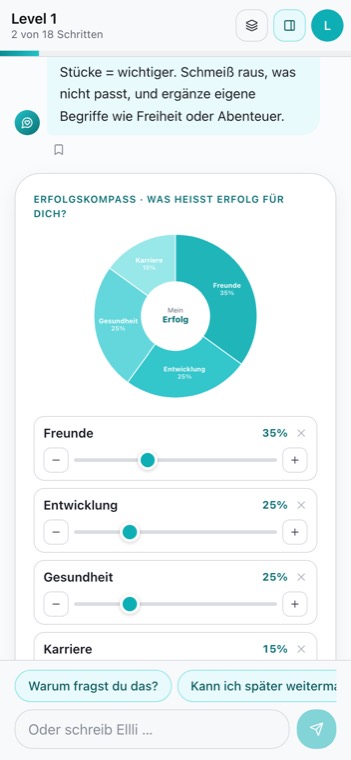
- Understand1 Understand yourself · 2 Inspiration
See work with new eyes
Thirteen lives for one job and 52 big challenges of our time open your eyes to what work can be.
Open the Zukunftsatlas - Try it out3 Find ideas · 4 Prototyping · 5 Learn
Think bigger and explore
You explore your interests and values. The Zukunftsatlas and Thirteen lives show you jobs and ways of life you have not thought of yet.
See Thirteen lives - Grow6 Plan, act, keep going
Go your own way
With our support, in a group and with Ellli, you find your next step. You try it on a small scale and talk to someone who inspires you.
Three principles from the science of individuality
Your profile is jagged
Your talent has many dimensions. No single test can capture who you are.
Context determines everything
You're introverted at events and extroverted at the table with friends. When you know these patterns, you choose more deliberately.
There is no normal path
In “The End of Average”, Todd Rose describes 25 ways to learn to crawl and 7 paths to success in science. Pace has nothing to do with ability.
Your Compass, a first try
You write two short texts and then check whether they fit together. They become your Compass for when you have to decide later. The idea comes from Bill Burnett and Dave Evans. The three examples are made up.
What is work for?
Write five to ten sentences. People work for money, for others, to learn something or to build something. Which of these counts for you? School, volunteering and helping at home count too.
What makes a good life?
Write five to ten sentences. What do you need for a day, a year or a whole life to be good? Think of people, places, time and whatever keeps you steady.
How others answered (invented)
Selin, 17
Work: For me, work is there so I can stand on my own two feet. I want to make things with my hands and see in the evening what is finished.
A good life: My family nearby, time for my friends and a quiet weekend.
A skilled trade in my town would make both possible. What is still open is how much money I need.
Tobias, 15
Work: Work should help others. I think of my grandpa in the care home and the carer who always has time for him.
A good life: People you can rely on. And music.
Both are about people. I wonder whether a demanding job would still leave time for my band.
Amara, 18
Work: At work I want to learn and help with problems that are bigger than me, for example climate protection.
A good life: Seeing a lot of the world and still having a home.
This is where they rub: big problems sound like travelling, a home sounds like staying. I want to find out more in a conversation with a climate researcher.
Do your two answers fit together?
- Where do your two texts fit together?
- Where do they contradict each other?
- Does one of the texts help you with a decision you are facing right now?
Next: What gives you meaning, twelve statements in five minutes
Try your next step on a small scale
You can imagine seven different lives. So try them. A prototype that fails teaches you more than a plan that never starts.
The simplest prototype is a conversation: you talk to someone who already lives what interests you and ask what their days are really like.
We call these prototypes tryouts: small tasks that test a hunch, such as "I think I’m good with my hands". What you show along the way stays in your path.
Learn
After every try you note: What did I do? What did I learn? What do I do next? That way every try becomes the next round.
Sheet: Done and LearnedWhat a tryout looks like
PreviewYou pick a tryout, go through it step by step and compare your answer. Then you say what you showed, and everything lands in Mein Weg.
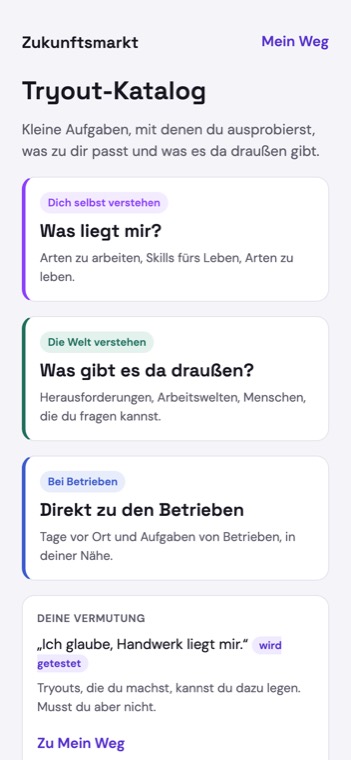
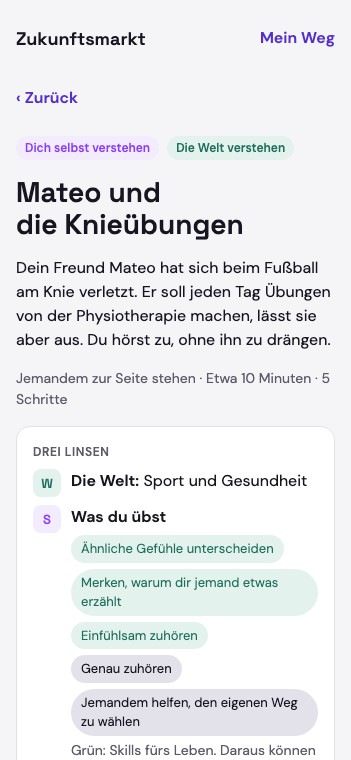
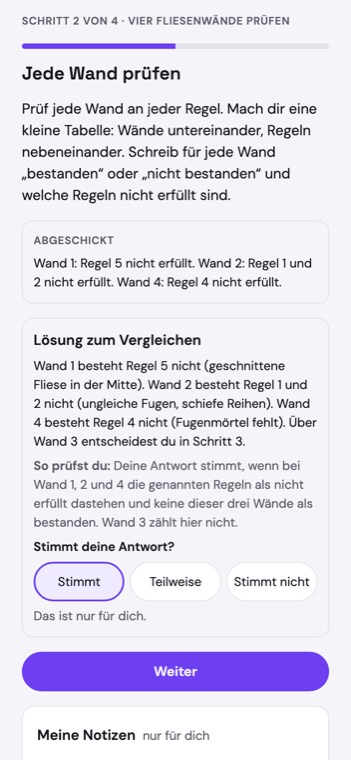
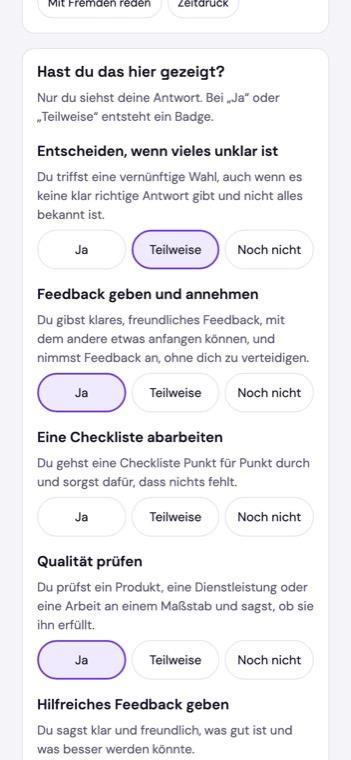
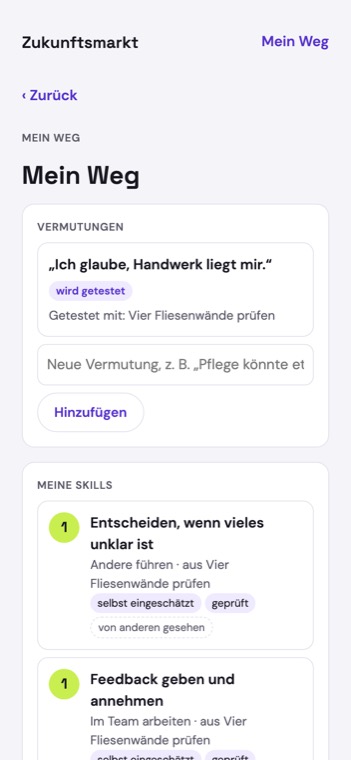
From the preview of the tryout catalog, with example answers (in German).
Life Design Canvas
In trial· in PotsdamYour life on one A3 sheet, station by station. Ellli guides you through 18 stations, from the first idea to your next step.
Tryouts
Being builtSmall tasks to try out what suits you and what is out there: prototypes for your life. Some you do on your own, some on site at a company. A first version is in testing with us, not public yet.
What you can do shows when you do it
Grades rarely show whether you work well in a team, speak in front of others or settle an argument. A record keeps what you showed in a tryout and who saw it.
Your view
You rate yourself first. That always counts and always comes first.
Shown in a tryout
What you showed in a real task. AI can give you feedback, but it never confirms anything on its own.
Confirmed by others
Teachers, companies or other people confirm what they saw. You always see who it was.
There are no points, levels or rankings.
Your records follow the open standard Open Badges 3.0. That makes them yours: you can add them to your CV, share them online or keep them in any collection that supports the standard. You decide what others see.
Status: we are testing records inside the tryouts. None has been issued yet.
Grow with people who mean it
Keep going
If you keep putting something off, that tells you something. Maybe the step is too big. Make it smaller until you can take it today.
Group and mentors
The biggest thing that shapes a transition is having the right people around you. A community that explores and reflects together.
Ellli, an AI assistant that grows with you
Ellli, our AI assistant, asks you questions, notices patterns in what you try, and helps you with your next step. Ellli doesn't replace people: the conversations in the group and with mentors stay at the core.
The agency profile
Being builtYou notice progress in sentences like: I act differently than three months ago. I decide more clearly. I know better who I am. The agency profile makes that visible, with five dimensions that develop independently of each other. It is not a score and not a ranking. The profile is still being built.
Self-clarity
I know what makes me come alive. I know my values, my flow moments, my patterns.
Decision-making
I can choose without needing to know everything. I decide, even when it's uncertain.
Putting things into action
I take action. I try things out instead of only thinking about them.
Self-efficacy
I believe my actions make a difference. I see myself as the one who shapes my path, not as a passenger.
Activating my network
I bring people in for my path. I ask for support and I give it.
Five attitudes
- •Wonder: let yourself be surprisedPractice, 3 min: Look around the room you are in, or out of the window. Find three things you have never noticed before, and write one of them down.
- •Readiness: stay open to what comesPractice, 3 min: Write down three small things you would normally say no to this week: a new dish, a different way home, an invitation. Circle one of them. This time you say yes to it.
- •Radical acceptance: see things as they arePractice, 3 min: Write down one thing that is annoying you right now. Make two columns: What can I not change? What can I change, even just a little? Pick one step from the second column.
- •Fully engaged, calmly detached: give everything, don't cling to the outcomePractice, 3 min: Before you start something, a presentation, a match or a job interview, write two sentences: What am I putting in here? What is out of my hands? Read the two sentences again afterwards.
- •Shape your world: you write your own story every day.Practice, 3 min: This evening, write down what you decided for yourself today. Below it, write one thing you want to do differently tomorrow, as precisely as you can.
Ready for your next first step?
Try it first, then decide.
Finding your next step is a skill you can learn. How to make yourself a new plan isn't in any curriculum. That's what we practise with you.