EducationFor parents · 4 min · 20 November 2026
How to help your child keep going

Sohrab Noorsalehi-Garakani“Dr. So”, co-founder of 2Morrow Lab
Guitar, running, coding: after two weeks the excitement is often gone. How to support your child in keeping going without checking in every evening.
Your child starts something new, for example practising guitar every day, going for a run in the morning or learning a programming language. The first week goes well. In the second it tails off, in the third it stops. You remind them, you ask, and at some point the hobby turns into something you argue about.
I'm writing this for parents who want to help their child keep going without becoming the control themselves. Here you'll find a simple framework and a few rules for your role in it.
What 30 days can do, and what they can't
Our Toolbox has the "30 Days, Keep Going" sheet, based on an exercise by Sebastian Kernbach and Martin J. Eppler. Your child picks one thing and does a little of it every day for 30 days. On day 31 they decide how to continue.
What can 30 days achieve? A research group led by Phillippa Lally observed how long it takes until a new daily habit runs by itself. In the study with university students it took 66 days on average. The range was huge: from 18 days up to a predicted 254 days. A single missed day hardly did any harm.
So after 30 days there is usually no firm habit yet. That isn't what the sheet is about either. The 30 days are a try. At the end your child knows how the thing feels in everyday life and can decide whether it is worth the effort.
How the sheet works
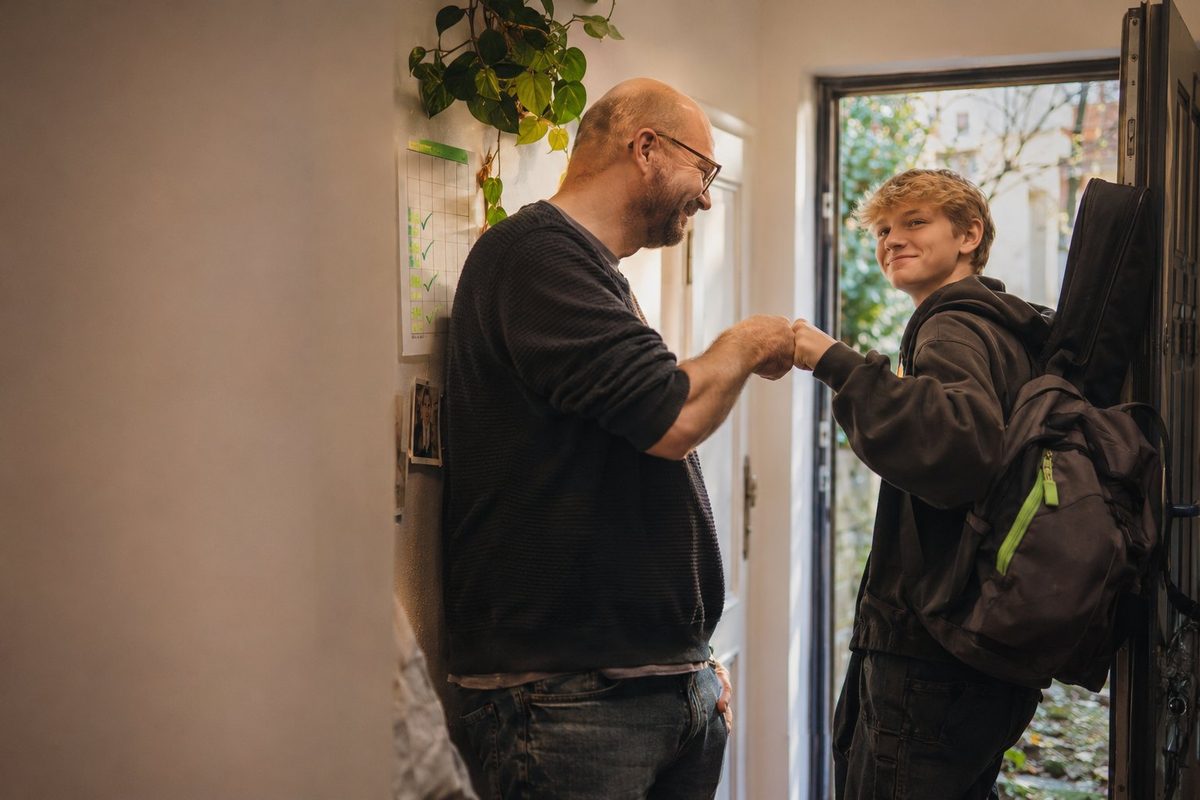
Your child chooses something that fits into a full school day: ten minutes of drawing, cycling to school, reading one page every evening. The sheet with the 30 boxes hangs where they pass it every day. Every day gets a tick. Anyone who misses a day carries on the next. After each week your child adds one sentence: What comes easily, what is hard?
On day 31 there are five possible answers: carry on like this, do more of it, do less, stop, or something completely different. Each of them is fine. "Stop" is a result too. Your child then knows that this thing doesn't suit them right now, and has room for the next one.
What you can do, and what you leave alone
- The sheet belongs to your child. You don't tick boxes, count gaps or ask every evening.
- Help your child find a fixed time of day and a quiet place, and make sure they have the materials they need.
- Join in. Choose your own thing for 30 days and hang your sheet next to theirs.
- At the weekend, ask what was easy and what was hard. Listen without jumping in with tips.
- Leave a missed day without comment. The sheet already says: just carry on.
- On day 31 your child decides. If they stop, take that seriously as an answer.
Kernbach and Eppler recommend doing a try like this together with others. So the sheet suggests that your child finds one or two friends who do their own 30 days at the same time. Your child decides who joins in.
What this can look like at home
An example: Jakob, 14 (invented), wants to draw for ten minutes every day. His mother decides to learn Spanish for ten minutes every day. Both sheets hang on the fridge. In the second week Jakob misses three days, his mother two. Nobody comments; both carry on.
On day 31 Jakob chooses "less": he only wants to draw at weekends, but for longer. His mother carries on with Spanish. Over dinner they both talk about what helped them on the hard days.
Then print out two "30 Days, Keep Going" sheets from the Toolbox, one for you and one to leave for your child.
To print: 30 Days, Keep Going
Sources
- Sebastian Kernbach, Martin J. Eppler: Life Design Actionbook, 2022
- Phillippa Lally, Cornelia H. M. van Jaarsveld, Henry W. W. Potts, Jane Wardle: How are habits formed: Modelling habit formation in the real world. European Journal of Social Psychology 40 (6), 2010, S. 998–1009, doi 10.1002/ejsp.674
- Christian Jarrett: How to form a habit. BPS Research Digest, bps.org.uk/research-digest/how-form-habit
Our newsletter tells you first when there are new texts and tools for families.
Go to the newsletter