AIFor parents · 4 min · 20 November 2026
Your child does homework with ChatGPT. Now what?

Sohrab Noorsalehi-Garakani“Dr. So”, co-founder of 2Morrow Lab
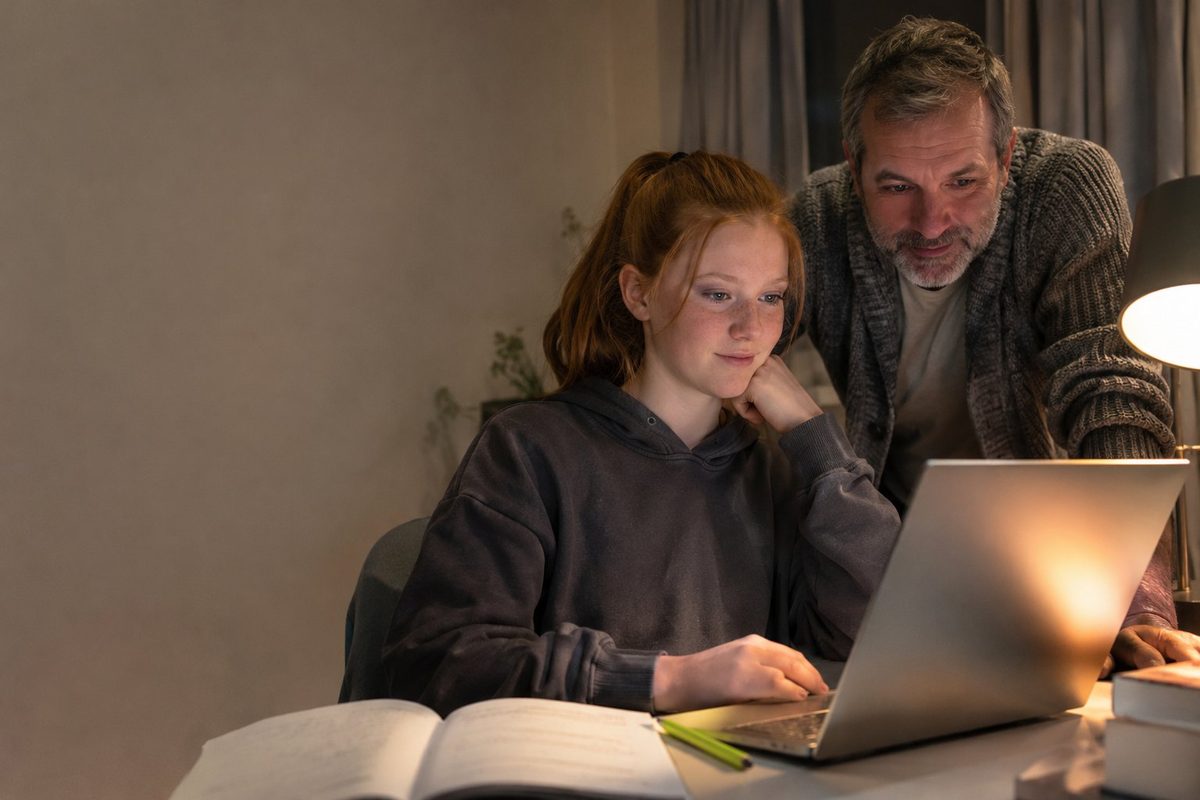
Almost three in four teenagers use AI for homework or studying. How to talk with your child about it without banning it or looking away.
Your child is working on a presentation, and ChatGPT is open in the browser. Maybe your first thought is: that's cheating. Maybe you think: as long as it gets done. Both miss the point. Whether AI helps your child learn depends on how they use it.
How many teenagers do this
For the JIM study 2025, the Southwest German Media Education Research Association (Medienpädagogischer Forschungsverbund Südwest, mpfs) surveyed 1,200 young people aged 12 to 19. 74 percent use AI applications for homework or studying. A year earlier it was 65 percent. 84 percent had used ChatGPT at least once, and 57 percent considered the information AI provides trustworthy.
The JIM study 2026 also asked how young people deal with AI answers in search engines. A quarter read only the AI answer and don't look at the other results.
What schools say about it
In October 2024, the Standing Conference of Education Ministers (Kultusministerkonferenz, KMK) adopted a joint recommendation from the federal states on dealing with AI at school. It calls for a constructive and critical approach: students should learn to use AI competently, and exam formats should be adapted to take these skills into account.
What this means for your child's homework can differ by school and teacher. Ask the teacher, for example at the next parents' evening: What is allowed? Does my child have to say when they have used AI?
Where AI helps with learning and where it cuts it short
Homework is practice. If ChatGPT solves a maths problem, your child ends up with a correct answer and has practised nothing. If they get an explanation of a method they didn't understand in class and then work out the next problem themselves, they have learned something.
A few examples of how AI can help with learning:
- Getting something explained again in a different way, for example with an example from football.
- Getting quizzed before a test.
- Showing it their own text, asking where it is unclear, and then revising it themselves.
- Collecting ideas for a presentation and then deciding themselves which ones are any good.
The learning disappears when the AI writes the essay, solves the problem or summarises the book your child was supposed to read. On top of that, AI answers can be wrong and still sound convincing. The research association that publishes the JIM study points this out too. Teach your child to look up important facts in a second source, in the textbook or on a website they know.
My rule of thumb: the AI may explain, quiz and give feedback. The thinking the task is about, your child does themselves.
Three questions for the kitchen table
I don't think a ban at home helps much, because AI is in every phone. I would talk with your child about it, curious and without interrogating. Watch your tone: if the first question sounds like an accusation, your child will show you little next time. Three questions help:
- "Show me how you use ChatGPT for homework." Ask to see a real task.
- "What did you do yourself, and what did the AI do?"
- "Could you do this without AI now?" If not, find a way together to use the AI so that your child practises along the way.
Done and Learned
At 2Morrow Lab the fifth step is called "Learn". After each try you note down: What did I do? What did I learn? The same two questions fit a homework task done with AI. If your child can answer the second one well, the AI has helped them.
Sources
- Medienpädagogischer Forschungsverbund Südwest (mpfs): JIM-Studie 2025, Pressemitteilungen vom November 2025, mpfs.de
- mpfs: JIM-Studie 2026, Pressemitteilung PM 2/2026, mpfs.de
- Kultusministerkonferenz: Bildungsministerkonferenz verabschiedet Handlungsempfehlung zum Umgang mit Künstlicher Intelligenz, Pressemitteilung vom 10.10.2024, kmk.org
- Sebastian Kernbach, Martin J. Eppler: Life Design Actionbook. Schäffer-Poeschel, 2022
Our newsletter tells you first when there are new texts and tools for families.
Go to the newsletter