AIFor you · 4 min · 20 November 2026
What AI changes in your dream job, and what it doesn't

Sohrab Noorsalehi-Garakani“Dr. So”, co-founder of 2Morrow Lab
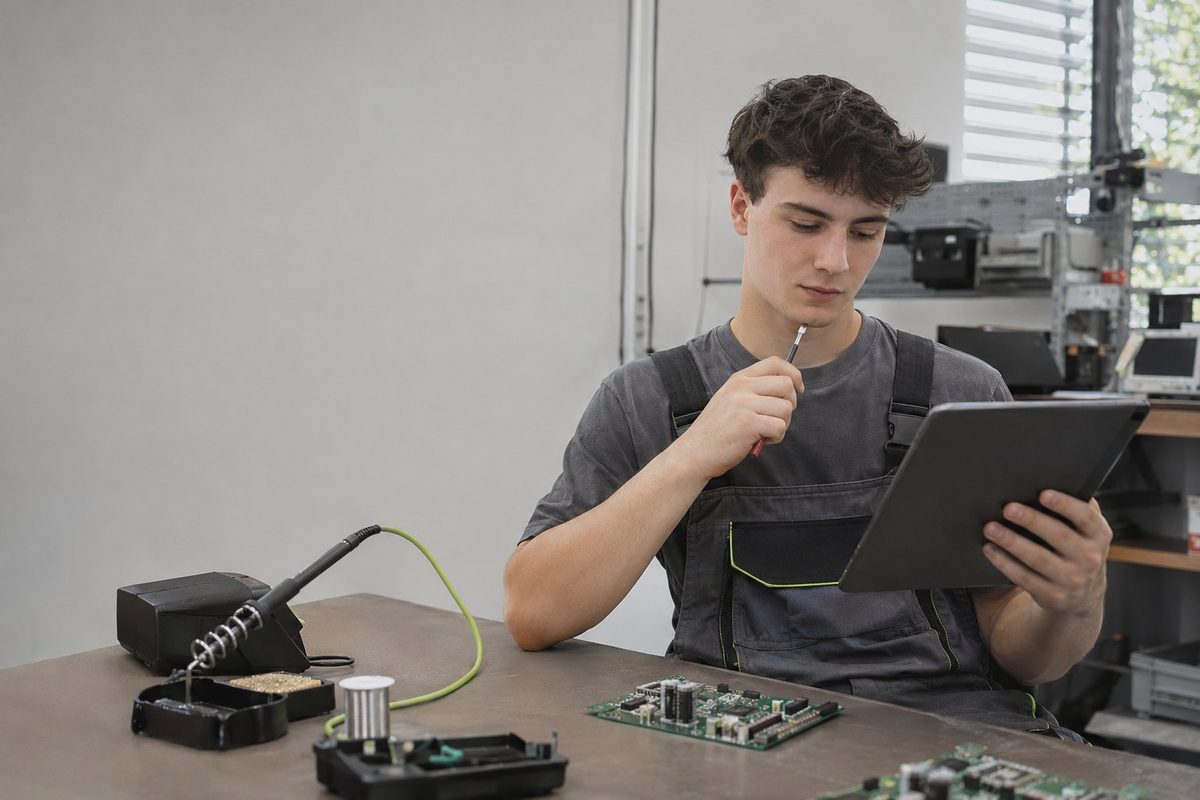
AI now writes texts and programs. Three questions and a free tool help you find out what that means for your dream job.
Nobody can tell you for sure whether your dream job will still exist in ten years, and neither can I. But you can find out which parts of a job are changing right now. That gives you something to plan with.
What the numbers say
The Institute for Employment Research (Institut für Arbeitsmarkt- und Berufsforschung, IAB) is the research institute of the Federal Employment Agency (Bundesagentur für Arbeit). Since 2013 it has calculated how many tasks in a job computers could already take over completely. To do this, three experts independently check more than 9,000 tasks from around 4,600 jobs.
The 2024 analysis is based on data from 2022. At that point, 38 percent of employees paying social insurance worked in jobs where computers could do more than 70 percent of the tasks. In 2019 it was 34 percent. The IAB names generative AI as the main reason for the rise: programs that write texts, answer questions and write code.
The figure rose most in IT and science jobs. In jobs such as software developer it climbed by about 30 percentage points, because AI now writes code itself. In social and cultural jobs, by contrast, little changed. Most people in this area work in education, childcare and social work, and according to the IAB the figure there is often low.
Jobs that need a university degree are affected too. For business economists in industry, the figure rose from 46 to 69 percent. The IAB report is titled (in translation) "Highly qualified workers in particular are feeling digitalisation more strongly."
What is technically possible and what actually happens
These numbers sound threatening. But the IAB itself writes that they only describe what is technically possible. A task a computer could do is not automatically replaced. People stay, for example, when they do the work more cheaply, more flexibly or better, or when laws and ethical questions stand in the way. And people value some work precisely because it is done by hand.
So a high figure means that the daily work in a job is changing. A software developer may write less code herself and check more of what the AI suggests. Whether the job disappears is something the figure can't tell you.
That is why I find a different question more useful: Which parts of my dream job stay with people, and do I like exactly those parts?
Three questions for your dream job
When you are thinking about a job, you can test it with three questions:
- What do people in this job do on an ordinary day? Write down five tasks, as concretely as you can.
- Which of them could a program do, and which need a person? I would pay special attention to where trust, hands and responsibility come in.
- Which of the human parts do you enjoy? If you like exactly those, the job may even have become more interesting for you.
You learn the most when you ask these questions to someone who already does the job. Also ask what AI has changed for them in the last two years. That way you hear what the work feels like from the inside.
Where to go from here
At 2Morrow Lab this step is called "Inspiration": you look at the world before you commit. In the Zukunftsatlas we show how AI is changing each field of study. There you will also find fields you haven't thought of yet, and you can try the three questions on them straight away.
You can also use AI yourself to explore a job. Ask a chatbot what a typical working day in your dream job looks like. Then check the answer with a person who does the job. Along the way you'll notice where the AI gets it wrong.
Sources
- Katharina Grienberger, Britta Matthes, Wiebke Paulus: Vor allem Hochqualifizierte bekommen die Digitalisierung verstärkt zu spüren. IAB-Kurzbericht 5/2024, Institut für Arbeitsmarkt- und Berufsforschung, Nürnberg
- IAB: Job-Futuromat, job-futuromat.iab.de
In the Zukunftsatlas you can see which jobs and paths exist and what they work on.
Open the Zukunftsatlas