Future of workFor you · 5 min · 26 November 2026 · updated 27 November 2026
Is an apprenticeship still worth it when AI knows so much?

Sohrab Noorsalehi-Garakani“Dr. So”, co-founder of 2Morrow Lab
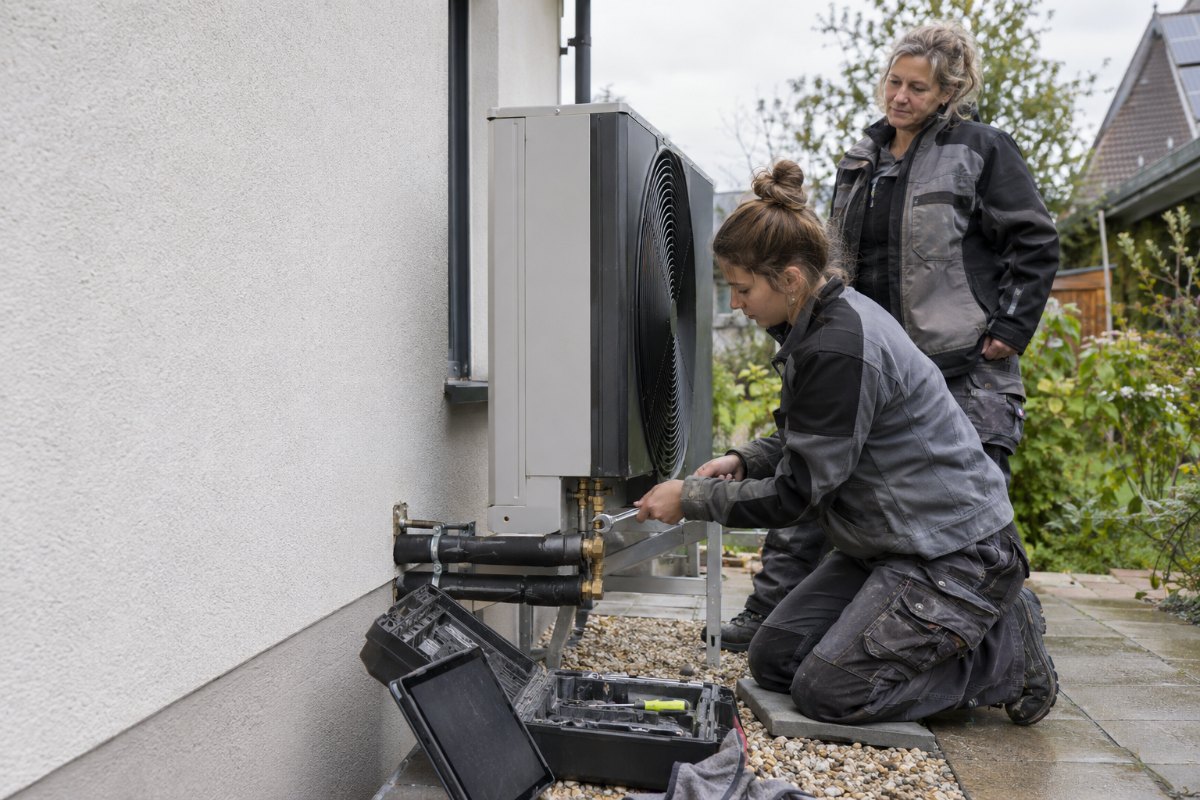
AI explains how a heat pump works in seconds. Someone still has to install it. What the figures say about apprenticeship occupations in Germany, and three questions to test an apprenticeship with.
In short
It depends on the apprenticeship. According to the IAB, computers could do 26.5 percent of the activities in health occupations in 2022, and 87.9 percent in manufacturing occupations. More of the work stays with people where it combines hands, being on site and responsibility for others.
An AI explains how a heat pump works in seconds. A person has to install it, connect it and sign for it. You could conclude that every apprenticeship (Ausbildung) is a safe bet. The figures from Germany show a more mixed picture, and it helps you to look closely.
Expert knowledge in your pocket
In their book "Messy Jobs", the economists Luis Garicano, Jin Li and Yanhui Wu describe a nurse on the night shift. She used to have to call the specialist with difficult questions. With a good AI she can settle a lot herself. The expert knowledge is in her pocket.
When knowledge is that easy to get, the authors think other things become valuable: that someone is on site, that people trust them and that they carry the responsibility. Many apprenticeship occupations consist largely of exactly that.
By their reckoning, though, this only leads to more pay under three conditions. Customers want more of the work when it gets better or cheaper. Not everyone is allowed to do it, because you need a qualification. And the tasks belong together so closely that the part done on a screen cannot be split off. The authors see this fulfilled in health care and the skilled trades, but not in purely clerical office work.
What the figures from Germany say
The Institute for Employment Research (IAB) calculates what share of the activities in an occupational field computers and machines could already do today. The newest values show the state of 2022:
- Social and cultural occupations, for example childcare: 13.5 percent
- Health occupations: 26.5 percent
- Construction and finishing trades: 42.5 percent
- Business management and organisation, which covers many office jobs: 68.0 percent
- Manufacturing occupations, for example at machines in industry: 87.9 percent
So there is no such thing as "the apprenticeship". Social occupations and manufacturing occupations are more than 70 percentage points apart. The skilled trades are not a field of their own at the IAB. Plumbing and heating count as construction and finishing, while electrical and vehicle trades count as technical manufacturing occupations, where the value is 74.8 percent.
On average, the value is even higher for occupations that need an apprenticeship (61.6 percent) than for occupations that need at least four years of university (35.8 percent). For the latter, however, it has risen fastest most recently.
The IAB itself adds that this is only about what is technically possible. Whether an activity is really replaced also depends on costs, laws and what customers want.
Where people are missing
The German Economic Institute (IW) calculated that the skilled trades in Germany were short of about 97,000 skilled workers in 2025. The gap is largest in building electrics (about 16,300), vehicle technology (about 13,300) and plumbing, heating and air conditioning (about 10,900). The Federal Employment Agency names care and health occupations as those with the greatest shortages.
That does not guarantee you an apprenticeship place. At the end of September 2026, according to the Federal Employment Agency, 46,000 applicants had neither a place nor an alternative. That was 10 percent. Whether you find a place depends a lot on the occupation and on your region.
And the money?
In 2022 the IAB compared what people earn over their whole working lives. Compared with people without a qualification, an apprenticeship brings about 243,000 euros more on average. Those who add further training afterwards, for example as a master craftsperson (Meister) or technician, reach about 780,000 euros more, and with a degree it is about 1.07 million euros.
So a degree brings more on average. The title of the report still translates as "A degree does not always guarantee the highest lifetime earnings", because it depends on the occupation. Master craftspeople with their own business are missing from the calculation.
And this is how apprentices see it themselves: in a 2026 survey by the Bertelsmann Foundation, 87 percent say they would choose their apprenticeship occupation again.
Three questions for an apprenticeship
You can test any apprenticeship that interests you with these questions:
- Does the work need my hands, or do I have to be on site for it?
- Do people trust me with something, such as their health, their child, their house or their car, and am I answerable for it?
- Do the tasks belong together so closely that the part done on a screen cannot be split off and given to a program?
The more often you answer yes, the more of the work stays with people. That does not make a job safe, but you know more precisely what you are getting into.
In the company, also ask how people there already use AI. In 2026 the ifo Institute tested with 673 apprentices in IT occupations what AI does in training. With AI they solved tasks that went beyond the curriculum much better. Only 16 percent had learned at vocational school how to use AI. So you teach yourself most of it, or learn it in the company.
What comes next
At 2Morrow Lab this step is called "Inspiration": you look at the world before you commit. How an apprenticeship, a degree and a volunteer year differ is in my text "Apprenticeship, university or time out first?".
To print: Conversation Guide
Related
Sources
- Luis Garicano, Jin Li, Yanhui Wu: Messy Jobs. The Work That AI Cannot Reach. Upriver Press, 2026
- Katharina Grienberger, Britta Matthes, Wiebke Paulus: Vor allem Hochqualifizierte bekommen die Digitalisierung verstärkt zu spüren. IAB-Kurzbericht 5/2024
- Institut der deutschen Wirtschaft: KOFA Kompakt 7/2026, Handwerk (Malin), Juni 2026
- Bundesagentur für Arbeit: Fachkräfte bleiben knapp. Presseinformation Nr. 32 vom 2.9.2026
- Bundesagentur für Arbeit: Ausbildungsmarktbilanz 2025/2026. Presseinformation Nr. 42 vom 30.10.2026
- Ein Studium garantiert nicht immer das höchste Lebensentgelt. IAB-Kurzbericht 18/2022 (Stüber)
- Bertelsmann Stiftung: Ausbildungsperspektiven 2026
- ifo Institut: Generative KI erweitert das Aufgabenspektrum von Auszubildenden. ifo Schnelldienst digital 21/2026
In the Zukunftsatlas you can see which jobs and paths exist and what they work on.
Open the Zukunftsatlas