Future of workFor you · 4 min · 27 November 2026
Do I have to study computer science to keep up with AI?

Sohrab Noorsalehi-Garakani“Dr. So”, co-founder of 2Morrow Lab
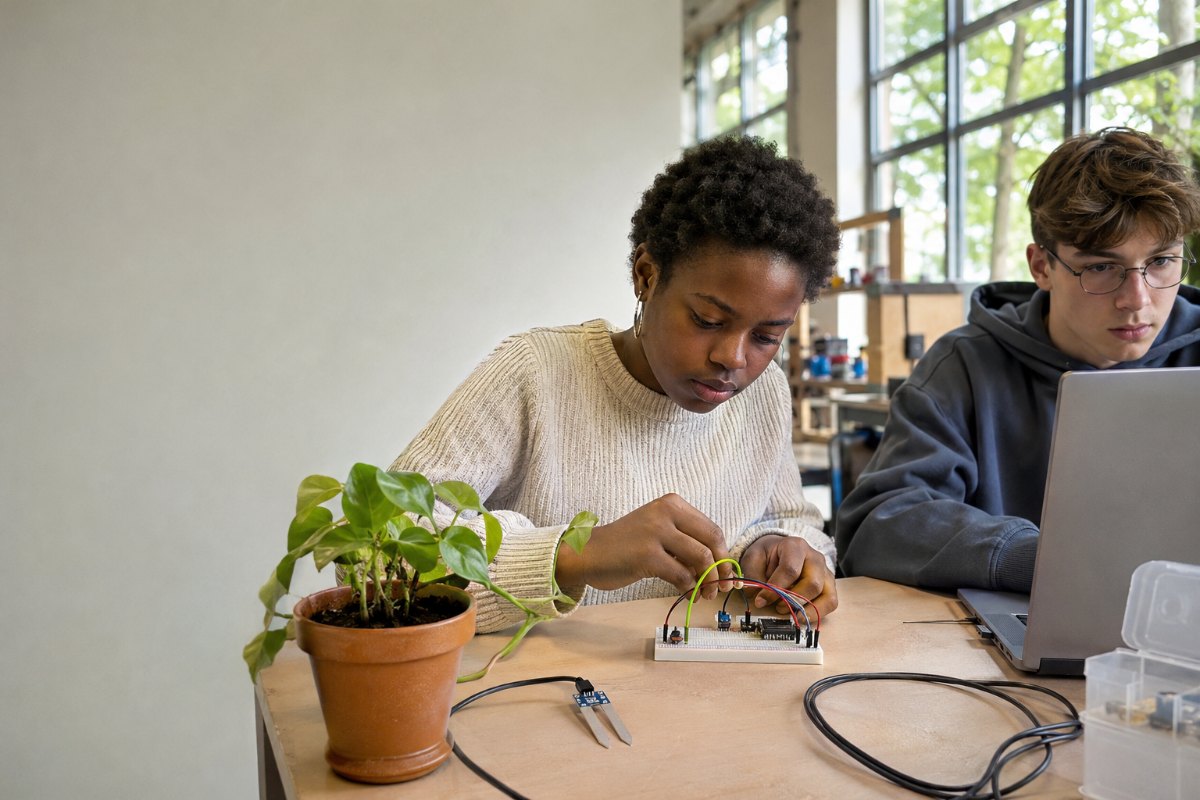
AI now writes code by itself. What the figures say about computer science in Germany, why AI is already needed in other subjects, and a question that helps you choose better.
In short
No. Computer science is in demand, but no longer as scarce as a few years ago. According to Bitkom, about 79,000 IT jobs were open in Germany in 2026, against 149,000 in 2023. According to the IW, two thirds of the job ads asking for generative-AI skills in 2024 were outside computer science. Pick a subject that grips you and learn to use AI well in it.
You are probably hearing two sentences at the same time right now. One goes: "Without computer science you have no future." The other: "AI will soon write all the code itself." The two don't fit well together, and neither is true as it stands. I'll show you what the figures from Germany say, and a question that helps you choose better.
How much demand is there for computer science right now?
There is demand, but it is no longer as scarce as a few years ago. In 2026 the German digital association Bitkom surveyed more than 850 companies. According to that survey, about 79,000 IT jobs in Germany were unfilled. In 2025 it was 109,000, and in 2023 still 149,000. Since 2025, Germany's Federal Employment Agency no longer counts software development among the occupations with a shortage of skilled workers.
Getting started has become harder. The job platform Indeed counted in 2025 that job ads for beginners in software development were 54 percent below their 2020 level, and for experienced staff only 15 percent. Why is unclear. According to Indeed, the decline started in spring 2022, before AI programs like ChatGPT were widespread.
In the Bitkom survey, 55 percent of companies expect classic entry-level tasks in IT to disappear more and more. 63 percent expect AI skills to be needed in all IT jobs.
Do you need AI only in computer science?
No. In 2025 the German Economic Institute (IW) analysed job ads that ask for skills in generative AI. Two thirds of them came from occupations outside computer science in 2024, most often from business organisation (14 percent) and from advertising and marketing (8 percent).
There are still few such ads. The IW counted about 18,000, which is 0.18 percent of all job ads. The direction is still clear: AI is becoming a tool in many jobs, the way spreadsheet programs once did.
What does a subject plus AI give you?
In their book "Messy Jobs", the economists Luis Garicano, Jin Li and Yanhui Wu advise looking where two fields meet. Their example is a lawyer who understands how AI models work. Such combinations are rare, because each side takes years.
That can be computer science, if it grips you. It can also be a biologist who can analyse her own data, or an electrician who programs the controls of a house. These examples are mine. They show that "keeping up with AI" means something different in every subject.
How do you know whether computer science suits you?
A degree takes years. Choose it because the subject itself interests you. Fear of AI will not carry you through five years. Three questions help:
- Do you enjoy breaking a problem down into small steps, even if an AI writes the code in the end?
- Have you ever built something, a website, a game or a small app, and wanted to carry on afterwards?
- Which other topic interests you so much that you would combine it with computer science?
If you hesitate at the first question and have an answer to the third straight away, maybe the other topic is your subject. Then that is where you learn to use AI well.
What comes next
At 2Morrow Lab this step is called "Inspiration": you look at the world before you commit. With the Curiosity List from our Toolbox you collect the topics that interest you. In the Zukunftsatlas you can see for each field of study how AI is changing it.
To print: Curiosity List
Related
Sources
- Bitkom: Der Arbeitsmarkt für IT-Fachkräfte. Studienbericht 2026
- Bundesagentur für Arbeit: Fachkräfte bleiben knapp. Presseinformation Nr. 32 vom 2.9.2026
- Indeed: Indeed-Analyse: Ersetzt KI Einstiegsjobs? Pressemitteilung vom 12.8.2025
- heise online: Bericht zur Indeed-Analyse mit Aussagen des Indeed-Ökonomen, 29.8.2025
- Jan Büchel, Jan Felix Engler: Generative KI. Ein Wachstumstrend. IW-Kurzbericht 38/2025
- Luis Garicano, Jin Li, Yanhui Wu: Messy Jobs. The Work That AI Cannot Reach. Upriver Press, 2026
In the Zukunftsatlas you can see which jobs and paths exist and what they work on.
Open the Zukunftsatlas