Future of workFor parents · 5 min · 26 November 2026 · updated 27 November 2026
Will there still be work for my child?

Sohrab Noorsalehi-Garakani“Dr. So”, co-founder of 2Morrow Lab
Almost every week someone says AI will soon take over office work. What three economists say against that, what the figures from Germany show, and what you can do at home.
In short
Nobody knows which jobs will exist in twenty years. But most jobs consist of many tasks that depend on each other, and AI takes over single tasks more easily than whole jobs. In Germany, the IAB found no reliable AI effect on young employees so far in 2026, but getting started in a job can become harder.
Almost every week you read a new headline: AI writes programs, contracts and doctors' letters. At the same time your child is supposed to choose an apprenticeship or a degree. Nobody knows whether today's jobs will still exist in twenty years, and neither do I. But there are reasons to stay calmer than the headlines suggest, and a few things you can do at home.
You are not alone with this worry
In 2024 the Körber Foundation had about a thousand parents of 12- to 18-year-olds surveyed in Germany. 66 percent fear that AI will replace many jobs in the long run. 29 percent worry that their own child will have worse chances of a good job because of it. At the same time, 89 percent are optimistic about their child's working future.
A job is more than one task
The economists Luis Garicano, Jin Li and Yanhui Wu published a book on this question in 2026. It is called "Messy Jobs". In their view, anyone who calculates how many jobs will disappear is counting single tasks. But most jobs consist of many tasks that depend on each other, and of people who have to agree.
The three explain it with a household. An AI program can switch your internet contract and book a holiday home. If your partner changed the holiday plans yesterday and the children refuse to go swimming, the booking does not help much. Someone has to talk, weigh things up and decide. Daily life in most jobs looks similar.
Take an electrician. An AI may be able to draw the wiring plan. Standing on the building site, working out with the owner what she really needs, checking the installation and signing for it all depends on one person.
What stays with people, according to the authors
- Work in which several tasks belong together and are hard to separate.
- Work in which people with different interests have to agree, and someone decides and carries the responsibility.
- Work we value because a person does it, such as care, teaching, a craft or a concert.
Single, clearly defined tasks are a different matter. AI already does some of them today, such as standard texts, simple translations and simple programs. The authors therefore expect a painful transition, followed by gains that reach many people. That is the assessment of three economists and no guarantee.
What history shows
The economic historian Robert Allen worked out how long such a transition can take, using the Industrial Revolution in Britain. Between 1780 and 1840, output per worker rose by 46 percent, while real wages rose by only 12 percent. Wages caught up only afterwards. From 1840 to 1900 they grew by 123 percent, faster than output per worker, which grew by 90 percent.
The new machines did not abolish work. But for two generations hardly any of the gain reached the workers. My reading is that both extremes can be wrong: the fear that work will end, and the promise that everything will sort itself out.
What the figures from Germany show
In October 2026 the Institute for Employment Research (IAB), the research institute of Germany's Federal Employment Agency, examined whether AI makes it harder for young people to start their careers. So far it has found no statistically reliable effect, and the weak economy weighs much more. The title of its press release translates as "AI not a job killer so far, but career starters increasingly affected".
In its 2026 report on the labour market for graduates, the Federal Employment Agency writes that AI can now take over many tasks that used to be meant for entry-level positions. In November 2026 the ifo Institute reported that in the occupations most exposed to AI, full-time employment of 20- to 24-year-olds has fallen by 14 percent since mid-2022. ifo does not treat that as proof that AI alone is the cause. So getting started can become harder, even if the jobs remain.
What you can do at home
You do not need a forecast for this. Three things help your child however fast the technology develops.
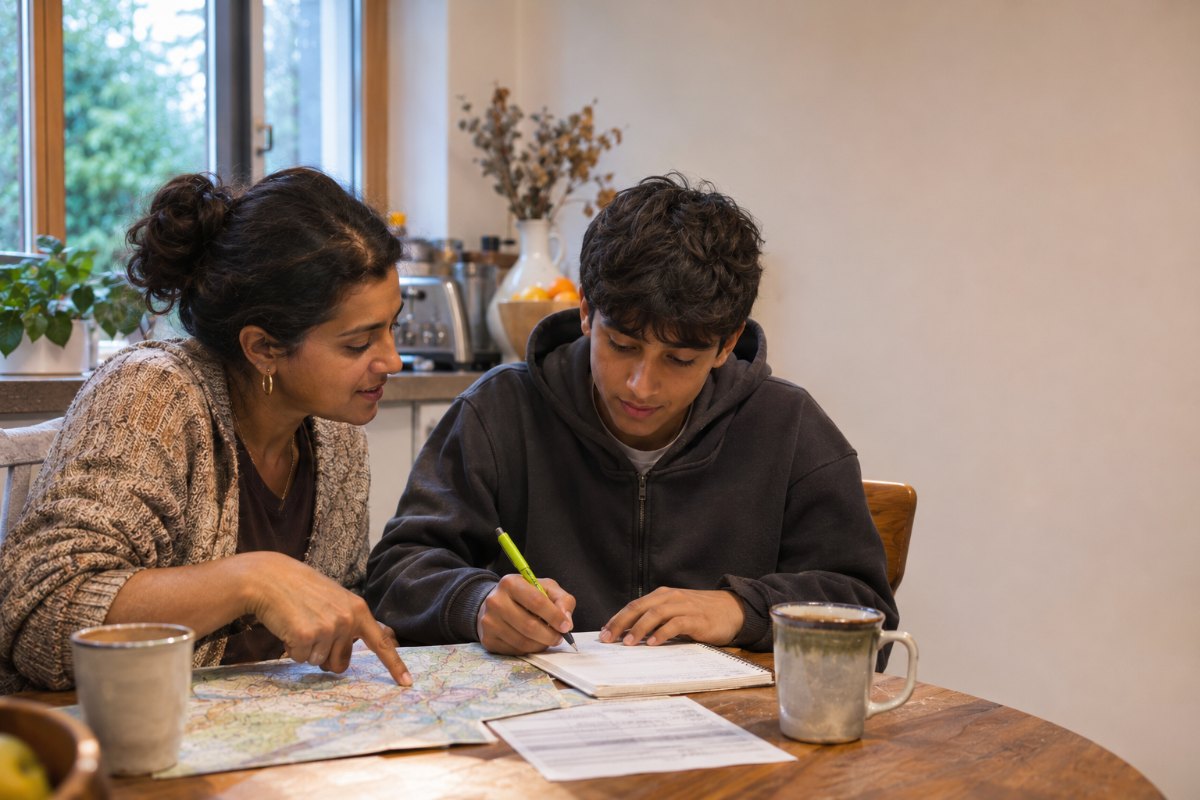
- Hand over real responsibility. Let your child plan the next family outing, with the budget, the timetable and everyone's wishes. That is practice in what is hard to hand to a program: weighing things up, reaching agreement and standing by the result.
- Bring your child together with people who do a job. Twenty minutes with the neighbour who is a physiotherapist show more than any list. Our Conversation Guide helps with the preparation.
- Talk about tasks when you talk about jobs. Ask, for example: "What does someone in this job do on a normal Tuesday? Which parts of that would you like to do?"
What comes next
At 2Morrow Lab this step is called "Inspiration": look at the world first, then decide. I have written up the same question for your child in a separate text. It is called "What AI changes in your dream job, and what it doesn't".
To print: Conversation Guide
Related
Sources
- Luis Garicano, Jin Li, Yanhui Wu: Messy Jobs. The Work That AI Cannot Reach. Upriver Press, 2026
- Körber-Stiftung: Eltern im Fokus 2024. Befragung von forsa, 1.007 Eltern von 12- bis 18-Jährigen, März 2024
- Robert C. Allen: Engels' pause. Technical change, capital accumulation, and inequality in the British industrial revolution. Explorations in Economic History 46(4), 2009
- IAB: KI bisher kein Jobkiller, aber Berufseinsteiger zunehmend betroffen. Presseinformation vom 13.10.2026
- Bundesagentur für Arbeit: Akademiker/-innen, Allgemeiner Teil, Stand Februar 2026
- ifo Institut: Frühindikator zeigt starke Wirkung von KI auf Berufschancen von Einsteigern. Pressemitteilung vom 9.11.2026
Our newsletter tells you first when there are new texts and tools for families.
Go to the newsletter